

A TOWN BUILT BY THE SEA
There are towns whose histories are written upon the land.
Ōamaru’s was written upon the sea.
Long before her pale stone buildings became admired for their beauty, before Harbour Street became a place for leisurely wandering, and before the old wharves fell quiet, Ōamaru was a town of ships and sailors, merchants and adventurers.
Her fortunes arrived upon the tide.
Wool and grain departed from her shores. Ships waited beyond the breakers. Sailors crowded her hotels and public houses. Great buildings rose from local stone as prosperity swept through the settlement.
And always, beyond the town, there was the sea — magnificent, necessary and, at times, merciless.
This is the story that inspired Quarterdeck.

CHAPTER I
WHEN FORTUNE CAME TO OAMARU
The 1860s brought with them a great air of possibility.
Gold had been discovered inland, drawing hopeful souls southward in search of fortune, while across the fertile plains of North Otago, great flocks grazed and fields of grain ripened beneath the southern sun.
Ōamaru found herself splendidly placed.
She became a gateway between the prosperous countryside and the wider world; a place through which wool and grain, people and provisions, fortunes and ambitions would pass.
Ships appeared upon the horizon.
Warehouses filled.
Merchants prospered.
The little settlement grew with remarkable confidence, and with prosperity came the belief that Ōamaru was destined to become a place of consequence.
And so she began to dress accordingly.

CHAPTER II
A TOWN RISES FROM STONE
From the earth surrounding Ōamaru came a stone unlike almost any other.
Pale and creamy, Ōamaru limestone was soft when newly quarried and could be carved by skilled hands into the most elaborate of forms.
And carve it they did.
Banks and warehouses rose beside hotels and offices. Great arches framed doorways. Columns marched proudly across façades. Cornices, scrolls and intricate embellishments transformed otherwise practical buildings into declarations of prosperity.
The merchants of Victorian Ōamaru were not inclined towards modest architecture.
They were building for the future.
And they wished the future to know that Ōamaru had arrived.
Much of their handiwork remains today, particularly around Harbour and Tyne Streets, where those magnificent pale façades still stand shoulder to shoulder.
Yet the prosperity that paid for such grandeur depended upon something far less dependable.
The harbour.

CHAPTER III
NEW ARRIVALS & BIG DREAMS
For all her good fortune, nature had neglected to bestow upon Ōamaru one rather important gift:
a safe harbour.
Cape Wanbrow afforded some shelter, but vessels anchored offshore remained terribly exposed when the weather turned.
And turn it did.
Before breakwaters and proper wharves, ships could not simply draw alongside the town and unload their cargo.
Instead, men took to surfboats.
These sturdy little craft carried goods and passengers between vessels waiting offshore and the beach, their crews judging waves and currents with a skill born of necessity.
To arrive in Ōamaru in those days could be quite an adventure.
When the sea prevented boats from reaching dry ground, passengers were sometimes carried through the surf upon the backs of boatmen.
One imagines that Victorian dignity became somewhat difficult to maintain under such circumstances.
But wet stockings were among the lesser dangers.
For the sea off Ōamaru could be unforgiving indeed.

CHAPTER IV
WHEN THE SEA CLAIMED HER OWN
Of all the vessels whose sails once appeared beyond Ōamaru's shore, few carried a story quite so remarkable as the Star of Tasmania.
She had been built in Aberdeen in 1856, in the great age of the sailing clipper, when a voyage to the far side of the world was measured not in hours, but in months.
And she was considered a beauty.
On her maiden voyage to Australia, the Cornwall Chronicle described her as a magnificent example of naval architecture, praising her spacious saloon, elegant ladies' cabins and excellent accommodation for passengers.
Yet even aboard such a fine vessel, travelling halfway around the world remained an adventure governed by wind, weather and fortune.
The Star of Tasmania was fast - exceptionally so.
On one celebrated voyage she covered the passage from Britain to King Island in Bass Strait in only 74 days.
But speed offered no protection from the hazards of the sea.
On an earlier voyage, while lying in Tasmania's Tamar River, fire broke out amongst blankets saturated with oil in her livestock stores. The alarm was raised, buckets of water were hurried into the hold, and the flames were extinguished.
The beautiful clipper had escaped disaster.
Her luck would not hold forever.
A FATEFUL VISIT TO ŌAMARU
By February 1868, the Star of Tasmania lay in the exposed waters off Ōamaru under Captain Andrew Culbert.
There was no safe harbour as we know it today.
No great breakwater reached protectively into the Pacific.
Ships lay anchored in an open roadstead, dependent upon surfboats to carry cargo and passengers between vessel and shore.
And aboard the Star of Tasmania was a fortune in North Otago wool.
More than 2,000 bales had been loaded for the long voyage to London.
Then, on 3 February 1868, the weather began to turn.
An easterly gale gathered strength.
The sea rose rapidly.
From the flagstaff ashore, the Blue Peter was hoisted - the signal warning vessels to abandon the anchorage and put to sea.
Smaller craft made their escape.
But out in the bay remained the Water Nymph and the Star of Tasmania.
And the wind continued to rise.
THE ANCHORS BEGIN TO FAIL
By the afternoon the gale had become ferocious.
At about half past three, observers ashore saw the Star of Tasmania begin to drift.
Her chain had parted.
For a time another anchor held her.
Then that too began to drag.
Imagine standing upon the Ōamaru shore and watching it unfold.
A great clipper ship - built to cross oceans, her masts towering above the water - being pushed helplessly towards land by a sea growing more violent by the hour.
Her crew fought desperately to hold her offshore.
But by approximately seven o'clock that evening, the final anchor could hold no longer.
The Star of Tasmania was driven towards the beach.
She struck stern first.
Then the waves swung the great vessel broadside to the shore.
And the sea began tearing her apart.
TWENTY-TWO SOULS
There were twenty-two people aboard.
Among them was Mrs Baker and her two young sons, along with another boy passenger.
The children had been placed in the forecastle, where it was believed they would be safest.
But there was nowhere truly safe now.
Wave after wave crashed across the ship.
The deck began to break.
The masts came down.
Water tore through her timbers.
Bales of wool - cargo destined for London - were ripped from the hold and washed into the raging sea.
Captain Culbert himself barely managed to scramble forward before the after-part of his ship gave way.
From the shore, rescuers managed to get a line to the wreck.
One by one, survivors were brought towards safety.
Eighteen would live.
But four would not.
Mrs Baker survived.
Her two little boys did not.
Neither did two sailors.
The sea that had brought prosperity to Ōamaru had, once again, demanded a terrible price.
AND STILL THE STORM RAGED
The Star of Tasmania was not the storm's only victim.
The Water Nymph was also driven ashore and wrecked.
The schooner Otago was forced onto the coast north of town after her rudder failed.
Ōamaru's jetty was destroyed.
Its surfboats were smashed.
Across the district, rivers burst their banks, homes disappeared beneath floodwaters and lives were lost.
The storm of February 1868 would become one of the great natural disasters of nineteenth-century New Zealand.
For Ōamaru, however, the wrecks delivered a particularly brutal lesson.
A prosperous town could build warehouses.
It could build banks.
It could send wool and grain around the world.
But until it could protect the ships upon which that prosperity depended...
the sea would always have the final word.
THE LADY WHO CAME HOME
And yet the story of the Star of Tasmania has one final, rather beautiful chapter.
At her bow had once stood a painted female figurehead - the elegant wooden lady you can see in our illustration.
She had faced the winds and seas as the Star of Tasmania crossed the world.
She had sailed from Britain to Australia and New Zealand.
And somehow, the story of the ship did not disappear entirely with the wreck.
Her figurehead survived.
The painted pine figure had been salvaged after the 1868 wreck by Captain Sewell, harbourmaster at Oamuru.
What happened to her after that is a mystery. However, according to Sotheby’s she was purchased in the 1950s by an antiques dealer after being found on a New Zealand farm blocking a hole in a hedge.
Today, more than 150 years after the Star of Tasmania was destroyed upon the Ōamaru shore, that weathered lady is preserved by Aberdeen Archives, Gallery & Museums in Scotland.
She has, in a sense, returned home.
The ship herself lies only in history.
But the lady who once stood upon her bow remains - a remarkable survivor from the age of sail, and a tangible link between a ship built in Aberdeen and a stormy February night on the distant shores of Ōamaru.
SOMETHING HAD TO CHANGE
For the people of Ōamaru, tragedies such as the Star of Tasmania could no longer simply be accepted as the price of doing business with the sea.
More than twenty ships would be wrecked upon this exposed coast between 1860 and 1875.
The town needed protection.
It needed sheltered water.
It needed a harbour.
And if nature had neglected to provide one...
Victorian Ōamaru was about to build its own.

CHAPTER V
TAMING THE SEA
The wreck of the Star of Tasmania was far from the first ship lost upon Ōamaru's coast.
Nor would she be the last.
But by the end of the 1860s, one thing had become painfully clear.
If Ōamaru wished to become a great port, it could no longer simply hope that the sea would behave itself.
Something rather more ambitious was required.
The town would build a wall into the Pacific.
AN EXTRAORDINARY PLAN
In 1871, work began upon what must have seemed an almost outrageous undertaking.
Engineer John McGregor had designed a great breakwater that would reach outward from the foot of Cape Wanbrow, gradually creating sheltered water where previously there had been little more than an exposed and dangerous anchorage.
But before the breakwater could march into the sea, the builders first had to reach it.
A tramway was constructed from the landing place at the south-western corner of the bay to the building site at the foot of the cape.
Rails, stone, machinery and men began to transform the shoreline.
By June 1872 the tramway was complete.
And on 10 September 1872, the first stone of the breakwater was laid.
Ōamaru had begun its battle with the sea.
BUILDING A WALL INTO THE PACIFIC
This was not a matter of simply tipping rocks into the water.
The engineers were attempting to construct an immense, solid structure while the Pacific continued to crash against the very place in which they were trying to build it.
Great concrete blocks had to be made, transported along the tramway and carefully manoeuvred into position.
And to lift them, Ōamaru employed an extraordinary piece of machinery.
A gigantic travelling crane worked its way along the developing breakwater, lifting the enormous blocks and lowering them into the sea.
It was said at the time to be the largest crane in the world.
More remarkably still, its design became a model for cranes used on other harbour projects.
For a small colonial town at the bottom of New Zealand, this was engineering on a decidedly grand scale.
Imagine standing upon the shore and watching it.
The hiss of steam.
The groan of machinery.
Chains straining beneath enormous blocks of concrete.
Men working above turbulent water.
And beyond them, the Pacific waiting patiently to undo their efforts.
FOOT BY PAINSTAKING FOOT
The sea was not easily conquered.
Progress was frustratingly slow.
By 1874, after years of work, the breakwater extended only about 300 feet — 91 metres into the water.
But they continued.
Block by block.
Foot by foot.
Year after year.
By 1878, it had reached approximately 940 feet — 287 metres.
And still they continued.
Eventually, in December 1884, the great structure stretched approximately 1,850 feet — 564 metres from the shore.
Where ships had once lain nervously exposed to easterly storms, there was now sheltered water behind an enormous protective arm.
Victorian Ōamaru had quite literally changed the shape of its coastline.
AND THEN CAME THE WHARF
Protection alone was not enough.
Ships needed somewhere to berth.
So while the breakwater was still advancing into the Pacific, another remarkable structure began to rise immediately inside it.
Macandrew Wharf.
Constructed largely of solid concrete and named for James Macandrew, the second Superintendent of Otago, the wharf opened on 5 May 1875.
Eventually extending a little over 100 metres, it was equipped with two 30-ton travelling cranes.
Steamers and coastal sailing vessels could now come alongside.
Cargo could be lifted directly between ship and shore.
The surfboats that had once battled passengers and goods through the breakers were no longer the only link between Ōamaru and the vessels beyond.
The harbour was becoming something entirely different.
It was becoming a port.
THE SEA WASN'T FINISHED YET
But perhaps the most remarkable thing about Ōamaru's breakwater is that its story did not end when construction finished.
The Pacific continued testing it.
In 1886, a violent storm tore a great gap near its end.
The breakwater was repaired.
Decades later, during the 1930s, it was again under threat.
This time men returned to the quarry.
Thousands of tonnes of rock were hauled out along railway tracks and tipped against the seaward face to create a great protective apron.
Much of that gruelling work was carried out by unemployed men during the Depression.
In total, some 7,550 tonnes of rock were placed beside the breakwater.
Still the sea persisted.
Extensions were attempted.
Repairs were made.
In the 1950s enormous 25-ton concrete tetrapods were positioned against it.
When the sea breached it again in 1977, great rocks were brought in once more and the damaged cavity repaired.
Generation after generation has maintained the same argument with the Pacific that McGregor's engineers began in the 1870s.
And remarkably...
the breakwater is still there.
THE WALL THAT CHANGED A TOWN
It is easy today to look across Ōamaru Harbour and see only a long arm of weathered concrete and stone disappearing towards the horizon.
But knowing its story changes it.
That breakwater helped make possible the harbour that allowed wool, grain and eventually frozen meat to leave North Otago for markets around the world.
It gave ships safer water.
It allowed wharves to grow.
It helped sustain the prosperity that paid for the extraordinary limestone buildings that still define Ōamaru today.
The beautiful Victorian town and the battered old structure reaching into the Pacific are, in many ways, part of the same story.
One could scarcely have existed without the other.
So if you wander down to the harbour during your stay at Quarterdeck, look towards the breakwater.
Imagine the rails running along its length.
The enormous crane inching forward.
The concrete blocks swinging above the water.
The men working against wind, spray and waves.
And consider what they were attempting to do.
They were not merely constructing a harbour wall.
They were building Ōamaru's future into the sea.

CHAPTER VI
FROM NORTH OTAGO PASTURES TO THE WORLD
The wharves became busy places.
Bales of wool arrived from the great pastoral stations.
Sacks of grain came from the fertile plains.
Men loaded ships bound for distant ports while carts, horses and railway wagons carried still more produce towards the waterfront.
Then a remarkable new technology changed everything.
Refrigeration.
New Zealand’s first successful shipment of frozen mutton and lamb left Dunedin aboard the SS Dunedin in 1882. Yet an important part of that pioneering story began here in North Otago, at Totara Estate, one of the Ōamaru district’s great sheep stations. Here, sheep were raised and fattened for a journey that would help transform the future of the region—and ultimately New Zealand’s agricultural exports. The meat travelled by road from Totara Estate to the railhead, then by train to the Port of Dunedin, where it was frozen and loaded aboard the SS Dunedin for the long voyage to London.
The successful shipment proved something extraordinary: for the first time, meat raised on New Zealand farms could survive the long journey to Britain, opening an entirely new market for the young colony.
Just two years later, in 1884, frozen mutton and lamb joined wool and grain on Ōamaru’s own wharves. The purpose-built refrigerated SS Elderslie began loading meat directly from Ōamaru for Britain, creating a direct link between the farms of North Otago and markets on the other side of the world. What had begun with sheep raised at Totara Estate and carried south to Dunedin could now leave for London from Ōamaru’s own harbour.
Imagine what that must have meant to a small town at the bottom of the world.
Produce raised upon the farms beyond Ōamaru could now be served upon tables half a world away.
The harbour had become the town’s doorway to the world.
CHAPTER VII
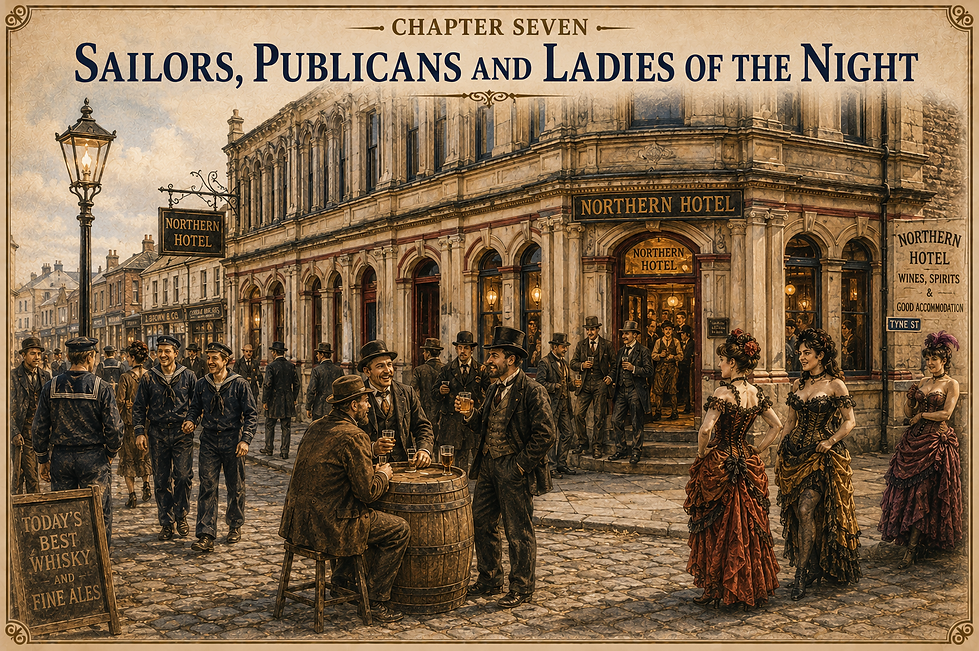
SAILORS, PUBLICANS & LADIES OF THE NIGHT
Prosperity, of course, did not arrive in Ōamaru wearing only its Sunday best.
This was a port town.
And port towns have always attracted a colourful collection of souls.
Ships brought sailors with wages in their pockets and precious little intention of spending all of them sensibly.
Hotels and public houses prospered. Gambling found willing participants. Sly-grog sellers did brisk business.
And where sailors and money gathered, so too appeared the ladies whose profession Victorian society preferred not to discuss in polite company.
Brothels became part of Ōamaru’s less respectable economy.
The town developed such enthusiasm for drink that it acquired the rather unfortunate reputation of being a “drunken metropolis.”
One historical account describes an Ōamaru of approximately 6,000 souls in 1881 supporting some 20 hotels, two breweries, 32 sly-grog shops and around a dozen brothels.
The magnificent banks may have closed their doors each evening...
but elsewhere in Victorian Ōamaru, business was apparently only just beginning.
CHAPTER VIII
WHEN THE TOWN WENT DRY
Such enthusiastic revelry could not continue without attracting opposition.
Across New Zealand, the temperance movement was gathering strength, driven by those who believed drink lay behind many of society’s ills.
Ōamaru eventually joined the cause.
In 1905, the electorate voted for No-License, and the following year the hotel bars closed.
The once notoriously well-lubricated town had gone dry.
Officially, at least.
For human ingenuity has rarely been entirely defeated by legislation.
Sly grog continued to find its way into private hands, and inventive arrangements were devised for keeping personal supplies conveniently close at hand.
One suspects that more than a few bottles continued to change hands behind closed doors.
The respectable Edwardian town may have renounced the bottle...
but the old port had not entirely lost its wicked little streak.


CHAPTER IX
THE LAST GREAT SHIPS
Ōamaru Harbour continued to change with the new century.
In 1907, Holmes Wharf opened, its enormous timber structure and railway lines capable of serving vessels far larger than those the first surfboat crews could ever have imagined.
For decades more, ships continued to come and go.
But the world beyond the breakwater was changing.
Roads improved.
Railways expanded.
Ships grew larger still, and international trade increasingly favoured ports able to accommodate them.
Slowly, the bustle faded.
Then, in 1974, the last coastal vessel carried commercial cargo away from Ōamaru.
The working harbour that had helped create the town had reached the end of an era.
The great ships departed.
The warehouses grew quiet.
The rails upon the wharves fell still.
Yet in that silence, something rather wonderful occurred.
The old Ōamaru remained.

CHAPTER X
WHAT THE SEA LEFT BEHIND
Today, the harbour tells its story more softly.
The great timbers of Holmes Wharf remain weathered by the southern air.
The breakwater still reaches defiantly into the Pacific.
Cape Wanbrow keeps its watch over the coastline.
And behind them stand the remarkable limestone buildings created during those extraordinary decades when merchants, sailors, farmers and labourers turned a young settlement into one of New Zealand’s most prosperous provincial towns.
Walk through the Victorian Precinct and you walk amongst their ambitions.
Wander down Harbour Street and look upwards.
Stand beside the old wharves and imagine the cries of sailors, the clatter of horses and carts, the creak of ropes and timber, and ships lying beyond the harbour preparing for distant shores.
The harbour may be quiet now.
But its ghosts are wonderfully easy to find.
AND SO, TO QUARTERDECK...
And here our tale finds its way back to you.
For the maritime character of Quarterdeck was never intended merely as decoration.
It is our small tribute to the extraordinary story outside its doors.
The colours and decor, the weathered timbers and nautical treasures you discover throughout the house are little echoes of an Ōamaru that once looked towards the horizon and saw its future arriving beneath a forest of sails.
A town of farmers and merchants.
Of architects and stone carvers.
Of sailors and surfboat crews.
Of wool, grain and frozen meat.
Of violent storms and shattered ships.
Of grand hotels and grander ambitions.
Of publicans, prostitutes, prohibition...
and more than a little sly grog.
But above all else,
a town built by the sea.
So, while Quarterdeck is your home, we invite you to wander down and discover the story for yourself.
Stroll along Harbour Street.
Lose yourself amongst the old stone buildings of the Victorian Precinct.
Walk out to the far end of Holmes Wharf.
Look towards Cape Wanbrow and follow the great breakwater with your eye as it reaches into the Pacific.
And then...
turn around.
Look back towards that extraordinary pale stone town and imagine the ships, sailors, merchants and dreamers who made it so.
For once you know the tale,
Ōamaru looks a little different.
And when you return home afterwards...
perhaps Quarterdeck will too.
QUARTERDECK • OUR MARITIME STORY
Written by Michele


DID YOU KNOW?
Curious details from Oamaru's fascinating history


